Showing posts with label Independent Clan. Show all posts

Tuesday, September 10, 2013

Late Review: Clanbook Ravnos


Clanbook Ravnos
By Christopher Walters
1997, 68 pages

            I have never had a player run a Ravnos character in any of my campaigns, and I’ve never used a Ravnos NPC in any of my campaigns.  To be quite honest, before reading Clanbook Ravnos, I knew very little about this clan.  They were vampire gypsies who like to steal or murder or whatever.  Other than their clan weakness and the potential game breaking awesomeness of Chimerstry, their signature clan Discipline, I couldn’t tell you much about the Ravnos.  Clanbook Ravnos changed all of that introducing me to the clan and their beliefs and politics.  I was happily surprised as I read through this clanbook and really couldn’t set it down.
            Written as if it were an inworld document, Clanbook Ravnos’s narrator is a European non-gypsy born before World War II who as a child meets a group of Gypsies whom he was taught to fear and hate.  However, when he sees children playing game no different from the games he played and meets the adults who are no different from his own family and neighbors, the child decides to join them and runs away from home.  Although his parents eventually find him and bring him back home, the narrator’s time spent with this kumpania or band of Gypsy, leaves a mark on him and the narrator travels with the Gypsies whenever he can.  When World War II starts the narrator loses track of his adoptive Gypsy parents and worries for them when he discovers that the Nazis are persecuting Gypsies as well as Jews.  After the war, the narrator searches out the surviving band and discover they have survived but only because of the protection of a Ravnos who Embraces the narrator. 
            The narrator of this introductory story remains the narrator throughout the rest of the clanbook, explaining to the reader who the Gypsies are, who the Ravnos are, and what their goals are.  The narrator is both an outsider and a part of the culture and this is the element that makes this clanbook work.  Many Americans and certainly Europeans and peoples from the rest of the world have very little contact with Gypsies or their culture.  Other than MyBig Fat Gypsy Wedding and the Brad Pitt film Snatch, I know very little about Gypsies.  Clanbook Ravnos pulls back the veil a little letting the reader view the culture and beliefs of the Gypsies of the World of Darkness (not the real world, mind you).  The author also includes a lexicon of language based on Rom, the Gypsy language, which he uses throughout the text.  This list of words is short enough that players could easily use them when role playing without needing to refer back to the clanbook.  The author doesn’t overuse these terms but uses them just enough to flavor the text and make it feel exotic.  I did have to flip back to the lexicon a few times, but soon I was remembering the words without difficulty.  In doing so, the author entices the reader to play a Ravnos which is by far the best thing anyone can say for a supplement.  After reading it, I want to play a Ravnos. 
This picture sums up everything I know about Gypsies. 
            The same narrator as the introductory story presents the history of the Ravnos from their days as exiles from the first city.  The kumpania (the words just fit right in) are traveling across the land along with the ancestors of the Silent Striders clan who were kinfolk or relatives to the Gypsies.  The band encounters Caine one night and allows him to travel with them.  The leader of this Gypsy tribe, a man named Tshurka, took in Caine and sheltered him as they traveled.  Although Tshurka made Caine agree not to feed from his people, Tshurka’s brother, the Silent Strider Pujinka, did not trust this outsider because of his tainted scent.  Caine and this group of gypsies traveled together for many nights, and Tshurka’s son, Ravnos, became infatuated with Caine and his endless life.  When the travelers reached a village, they found it was under attack by some of Caine’s childer.  These vampires attacked the Gypsies as well, killing Tshurka.  Ravnos ran to Caine and begged him to turn him into a vampire so that he could fight Caine’s other murderous children.  When the other vampires had been defeated, Ravnos took it upon himself to protect his tribe with the new powers that he had received from the Embrace.  Pujinka took the Lupines and left the Gypsies behind shattering the tribe into two parts, the Lupinos and the Ravnos. 
            No history of the Ravnos can be complete without also discussing the history of the Gangrel and their Antediluvian Ennioa.  During his travels, Ravnos encountered the beautiful woman, Ennoia, as he approaches a marvelous city.  Ennoia has been banished from the city, but Ravnos invites her to stay with him.  They fall in love, and eventually, Ravnos Embraces Ennoia.  Together they climb the walls of the city and steal from the residents and play tricks on the vampires who reside behind the walls.  However, Ennoia becomes bored with living as Ravnos’s wife; because she is one of Lilith’s children she wants to be free and wild and control her own destiny.  To that end, Ennoia makes a deal with some of the vampires living in the city, offering to turn Ravnos over to them in exchange for her own safety.  Then, she’ll claim that Ravnos told her to take charge of the kumpania and lead them away.  Things go as planned, but Ravnos’s sister has a vision of Ennoia’s treachery.  Ravnos is caught and staked and left to die in the sun, but when Ennoia returns to the Gypsy’s camp, she is caught.  The Gypsies have a trial and before they can punish her, Caine arrives and curses Ennoia to take on the countenance of a beast and to wander alone.  She falls on all fours and turns partly into an animal and races off into the night. 
            The antagonism between the Ravnos and Gangrel clans is a core element of this book and the Ravnos culture.  According to this story, Ennoia and the whole Gangrel clan are subject to a curse beyond the curse of vampirism.  Not only are they are cursed by Caine to be bestial and to wander alone, but they also subordinate to the Ravnos clan because it was Ravnos who created the Gangrel.  Clanbook Gangrel gives a completely different version of the events with the Gypsies and Werewolves being the descendents of Ennoia prior to her Embrace.  The hatred between these two clans adds depth to the jyhad, and this history, true or not, explores the genesis of an ages old feud that is at the very heart of Vampire the Masquerade. 
            From the ancient world and into modern day, Gypsies have always been outsiders moving constantly across the landscape.  The Gypsies and the Ravnos has spread across Europe, the Middle East and India and eventually to the New World.  During their travels they have met a variety of strange supernatural creatures including the mysterious Kindred of the East and shape changers such as Bastet in Africa.  When the Ravnos first arrived in the Americas they were surprised to find that some of their clan was already here living amongst the Native American populations.  The Ravnos Neve, or New Ravnos, helped their tribes fight against the encroachment of the Europeans settlers and some Old World Ravnos even assisted.  However, this was in vain.  Most of the Ravnos stayed out of the conflict as it had nothing to do with them. 
            That is one of the key aspects of Ravnos culture: they are not a part of European or American culture, Kindred culture, or any other culture.  The Ravnos follow their own laws and stick to their own beliefs.  The tribal, itinerant culture of the Gypsies and the Ravnos sets them apart from the societies that they travel through.  They don’t respect borders or laws.  They take care of their own and are essentially closed groups.  The Ravnos don’t steal; they borrow things that you aren’t using.  Or at least that’s the reasoning of narrator.  If nothing else this book does an exceptional job of enticing the reader to sympathize with the Ravnos who have long been the victims of oppression and hatred culminating in the Tremere and Camarilla siding with the Nazis to help exterminate both the Gypsies and the Ravnos. 
            Chapter Three describes the three key divisions amongst the Ravnos:  Phralmulo, Georgio, and the Anti-tribu.  The Phralmulo are those Ravnos who were born Gypsies and eventually Embraced by a member of the clan.  The Georgio are outsiders who, for whatever reason, were Embraced by a Ravnos.  The Anti-tribu are the Ravnos who after World War II decided to join the Sabbat to get revenge on the Camarilla for taking part in the atrocities perpetrated by the Nazis.  All Ravnos player characters are considered to Georgio, unless the Player purchases a Merit called Phralmulo.  The benefit of the Merit is that the Ravnos doesn’t have to select one vice or crime that the PC must commit; instead, the Ravnos has better control of himself/herself.  Rather than focusing on one crime, the Ravnos Phralmulu uses his criminal impulses as a weapon to retaliate against the Camarilla, Sabbat, or other forces that want to oppress the Ravnos and Gypsies whom they protect. 
The facial shadows are more disturbing than the illusions.
This interpretation of the Ravnos weakness is one of the best parts of this book because it gives a Ravnos PC a purpose beyond just random criminal acts to meet the requirements of their weakness.  Crime is not a crime, but instead a tool for political gain and a weapon to be used against the enemies of the clan.  Theft isn’t for personal gain or desire.  Theft deprives the enemy of necessary resources.  Murder becomes assassination.  The Ravnos aren’t criminals.  They are guerillas fighting an insurgency against the powerful forces of the Camarilla and Sabbat and Anarchs who oppress them.  As a Storyteller, I wouldn’t require Players to spend points on the Merit “Pharlmulo” if they wanted it because this interpretation makes a Ravnos PC more sympathetic and exciting to play.  The Ravnos now have a goal beyond just crime for crime’s sake.  
There are several other groups within the Ravnos clan.  The most noteworthy is the Wuzho who hunt and murder other Kindred.  These Ravnos believe that they must destroy other vampires in order to protect their clan.  Essentially, these are the Assamites of the clan.  The Wuzho would make for great NPCs and antagonists for a Camarilla Chronicle, but Storytellers should be careful about allowing players to use this group because the last thing a player needs is another excuse to PVP.  Another group within the clan is the Urmen who have a connection to the Fae of Changling the Dreaming.  The Urmen enjoy getting high by drinking the blood of the Fae and exploring the wilderness.  They are the masters of tracking down Changelings and draining them of their blood.  These would make a great addition to a mixed group game that involves Changeling and Vampires.  A sidebar in Chapter 3 discusses how Changelings interact with Chimerstry effects. 
Clanbook Ravnos also includes several new high level Disciplines and other mechanics that Storytellers could use in their Chronicles.  Ravnos can make use of Samadji, or artifacts, that are passed down from Sire to childe.  Some are beneficial and others are cursed.  Samadji vary in power and usefulness, and unfortunately there are no good examples given on which players can base their own artifacts.  Ravnos are also given a new level 6 Animalism power, Deep Song, a level 6 Chimerstry power, Fata Amria, and a level 8 Chimerstry power, Sensory Overload.  Deep Song, which alters a target’s emotions, doesn’t make sense as an Animalism power.  Animalism either affects animals or another vampire’s Beast.  This does neither and would fit better with Presence.  The Chimerstry powers are wonderful, if a player can ever get to a low enough generation to actually acquire them.  A couple of addenda are included for Fatuss Mastery and Psuedo Blindness that explain how Chimerstry works in relation to the Penumbra and Shadowlands. 
His name is Sir Stabs-a-Lot.  Guess who he's stabbing next?
Chapter Four offers a selection of pre-generated characters that could be useful as either PCs or NPCs.  These templates could easily be modified for use in Vampire the Masquerade 20th Anniversary Edition, and the descriptions of each character is full of ideas for players looking to create their own Ravnos.  Each template builds on the character’s weakness, the particular crime that the Ravnos must commit, and generates an entire character around it.  Of the templates, two stand out.  The first is the Ace of Spades who is a sociopathic murderer.  The Ace is a dangerous character concept because it, like the Wuzho, could inspire players to build sociopathic loners who kill first and may later ask questions. These types of characters have a tendency to be disruptive unless the Chronicle is focused on combat.   The best character concept is the FX Artist who feels a compulsion to trick people.  Using the illusion based powers of Chimerstry, this character brings to live the horror and scifi film monsters to terrify the real monster of the world.  Rather than steeped in angst, this character concept embraces the fun of living forever and being able to play tricks on stuffy Camarilla Elders.  The other templates run the range from a Subway Conman to a Globetrotting Smuggler showing the variety of characters and adventures possible in the World of Darkness.
The Appendix includes four renowned NPCs that Storytellers can draw upon for their games.  Unfortunately, these NPCs are ciphers.  They are written too broad and rather than have their own personalities, they are designed to be anyone.  One of the NPCs, Ezmeralda may be a Kindred or may be the guise of a number of mortal women over the centuries.  Spider-Killer could be a Ravnos Neve or he could be a were-coyote.  Only Ivan Krenyenko and Durga Syn have any personality of their own.  Rather than including more fleshed out NPCs that could inspire a Storyteller to create adventures around these characters, these NPCs are nothing more than names with no goals. 
Clanbook Ravnos is exceptionally well written with lots of information for players who want to run a Ravnos character or for Storytellers who want to introduce plots involving Ravnos characters into their games.  As good as Clanbook Ravnos is, it does have problems.  The most notable problem is that Clanbook Ravnos is not a standalone book.  The author references World of Darkness:  Gypsies several times.  Apparently Gypsies get access to special powers because of their blood, and their blood is very tasty to vampires for some reason.  Without World of Darkness:  Gypsies, some sections of this book will remain a mystery, and unfortunately World of Darkness Gypsies is one of the most reviled books released by White Wolf.  The artwork for this book lacks a lot of detail and the artist overuse shadow masking half the faces in many of the images.  It looks messy rather than moody.  Along with the problems with the Appendix’s lack of strong and useful NPCs for the Storyteller and issues with the murderous, sociopath archetype of the Wuzho, this book has its problems. 
            Despite these minor flaws, Clanbook Ravnos is an excellent supplement for players and Storytellers who want more information on how to role play a Ravnos.  Like Clanbook Assamite, this book explores and explains the culture of the Ravnos without falling into the trap of stereotyping the clan as just thieves and conmen.  The author makes the Ravnos sympathetic characters by reminding the reader of the ancient prejudice against the Gypsies and the atrocities perpetrated on them by the Nazis.  The best review that I can give for a book is that it has inspired me to want to play one the clan, and so far this one of my favorite clanbooks.  I am really looking forward to playing a Ravnos the next chance I get to play Vampire the Masquerade. 
            Clanbook Ravnos is available as a PDF on DriveThruRPG or you can purchase an original printing from Amazon. 

Tuesday, June 4, 2013

Late Review: Clanbook: Assamite


Clanbook:  Assamite
By Graeme Davis
1995, 66 pages

Offensive accent included free of charge!
            I have a severe bias against the Assamite clan.  When I first started playing RPGs back in the ‘90s, my group included too many power gamers, and Clan Assamite is a power gamers wet dream.  The clan’s disciplines, Celerity, Obfuscate, and Quietus, are a wet dream for any player who wants to make an unstoppable murder machine.  The Assamites operate beyond the laws of the city’s Prince or Primogen.  They answer only to their clan’s leaders (with the obvious exception of the Assamite antitribu).  Most importantly, since most Assamites follow the Path of Blood, they aren’t held to the normal morals against killing; instead, they are expected to kill, ruthlessly and efficiently for their elders.   This combination of factors draws power gamers or just players who want to be “evil” for the sake of being evil.  My bias is based on disruptive nature of the kind of player who loves to be the evil badass assassin that murders at will.           
             However, Clanbook Assamite doesn’t devolve into glorification of the wet dreams of power gamers, but this book does contain some powerful artifacts and new powers to tempt those power gamers who read it.  The most surprising element of this clanbook was a clear and consistent theme of anti-colonialism with Caine as the original villainous colonist destroying the sanctity of the first city.  Using this theme the book expands outward taking the Assamite clan and developing it into its own sect, separate from the rest of Kindred, with its own vocabulary, view on vampire history, and methodology.  Instead of falling into the trap of making the Assamites another paper thin, evil organization, the clan is given depth as well as breadth. 
This fucking guy turned Africa into a graveyard
            While many other clans have an idyllic view of the founding of the 13 clans and the utopia of Kindred rule, the Assamites see a history of invasion and occupation beginning with the arrival of Caine.  Caine entered Enoch, the first city, and turned the king and queen into vampires like himself.  However, Haqim, the Assamite Antediluvian and the general of the armies of Enoch, saw his king and queen corrupted by the invader Caine.  He slew the king and queen and took their blood to turn himself into a vampire.  He battled Caine but was defeated.   Haqim’s most loyal soldiers saved him and together they traveled into the mountains to wage a war against the monster that had conquered his home.  From the greatest of his soldiers, Haqim created the Assamites to continue his war for revenge against Caine’s corruption of his city and king.  The Assamites have since sold their skills as assassins to other Kindred under the theory that they can doubly profit by gaining Kindred Blood, which they use for an elixir to lower their generation  circumventing the Tremere curse and their clan weakness, and they can destroy other vampires which they would do regardless.  
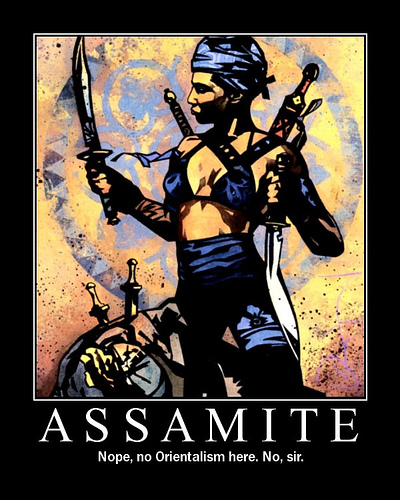
            Without turning this review into a discussion on colonialism and post colonialism, Clan Assamite’s history of the Kindred is reminiscent of any number of colonial adventures, whether it’s the conquest of the Aztecs and Incas by the Spanish conquistadors, the British colonization of India, the Belgians conquest of Africa, or the Soviet Union’s war in Afghanistan.  Because the Assamites were regarded as a continuation of racist Middle Eastern stereotypes, White Wolf needed to offer a more nuanced view of the clan and move them beyond the stereotype.  By creating a history of colonial conflict from the clan’s founding, Clanbook:  Assamite avoids those same stereotypes, and the author even includes suggested reading material to further enlighten players about Middle Eastern and Islamic culture. 
Revised Edition Assamite
            Of all the clans, the Assamites have the most strict rules on selecting potential initiates who must be selected by the Elders of the clan for introduction into a training program that prepares the initiates for the Embrace and membership in the clan.  Potential Assamites are typically drawn from the ranks of soldiers, freedom fighters, mercenaries, and others with a combat focus, but specialists such as scholars, scientists, and occultists are also Embraced rounding out the clan.  The clan itself is hierarchical with the Master, the Old Man of the Mountain, making decisions alongside a council of Elders, the Du’at, made up of the Assamite warlord, the Caliph, the chief scholar, the Vizier, and the head priest, the Amr.  Below these are the Silsila or the clan’s elders.  Finally there is the clan’s rank and file, the Rafiq, and the newly embraced initiates or the Fida’i.  The clan is divided into three further groups based on their skills:  The Scholars, the Warriors, and the Magi.  The expansion of the Assamites beyond just a clan of assassins allows for a wider variety of potential characters rather than the usual professional soldiers. 
Let's avoid the ninja with big boobs stereotype too, please
            But no matter how rigidly structured or well-trained a group of assassins may be, without a code of conduct, they are just a sociopathic cult.  The Assamites code is the Khabar, and it defines the clan’s activities.  Loyalty to the clan is the penultimate decree.  Beneath loyalty, the Assamites value Brotherhood, Honor, Vengeance, Secrecy, Faith and Community.  The overlapping values of Loyalty, Brotherhood, and Community define this deeper view of the clan while Vengeance against the Kindred who corrupted the First City continues the theme of anti-colonialism.  Also, Clanbook:  Assamite introduces players to first mechanics for the Path of Blood and the morality of the Assamites. 
            As far as systems and mechanics, Clanbook:  Assamite offers a selection of the useful and the overpowered.  Alchemical dusts that replicate abilities of the discipline Quietus offer single use items that can be given as rewards to neonate Assamite characters that haven’t developed Queitus fully.  Kali’s Fang, on the other hand, is a weapon that always does aggravated damage and can destroy a vampire if it strikes the vampire’s heart.  Kali’s Fang could be one of the most powerful items in the game, and except for story purposes, Storytellers shouldn’t let players acquire it.  The new Merits and Flaws provide allies for the Assamite amongst the Assamite Antitribu or the Marijava ghoul family and enemies amongst the Assamite Antitribu, the Assamite Elders or the Du’at, the Assamite’s ruling council.  All of these are helpful for explaining why an Assamite might travel with a coterie. 
High level options for the Assamite’s signature Discipline, Quietus, are given including two for the sixth rank and one for the seventh rank and one for the eighth rank.  As with all Disciplines beyond the fifth level, these can be either overpowered or just generally useful.  Some new Thaumaturgy Rituals are also included.  A Level 5 ritual that turns any artificial light source into a potent weapon that replicates the effects of sunlight could be overpowering, but the Ritual only last for two to ten minutes.  A level seven ritual also allows a character to heal aggravated wounds as if they were normal wounds. 
Step 1 is always be sneaky!
New Secondary Abilities, weapons, and combat systems are included that expanded on the Second Edition systems, but these are not useful for groups who have migrated to the 20th Anniversary Edition.  The weapons could be easily brought over into V20 with little work.  However, the existence of these systems and abilities may offer some suggestions for players who want to create a character that uses exotic weapons such as a blowgun or garrote. 
Because of the Assamite’s historic hatred of the other clans, Storytellers will need a reason why an Assamite has joined a coterie of infidels.  The section Leopards Among Jackals offers three reasons methods for a Storyteller to include Assamites in traditional coteries.  The most obvious is Secret Teams where an Elder would assemble a group of neonates to complete a task.  The hiring of an Assamite for such a group adds combat and stealth ability to this “Dirty Dozen” assembled by a resourceful Elder.
The templates section carries a great mix of both stereotypical and unique concepts for Assamite player characters.   The stereotypes are cut from the same cloth representing the most obvious options for Assamite characters.  The Holy Warrior, Professional, Mercenary, and Avenger are typical Assamite warriors.  On the other hand, the Playboy concept is a charming thief who uses guile, seduction, and his wits to take advantage of his victims.  Furthest from the archetypal assassin is the Scholar Template who was a mortal scientist that was hired to find a cure for the Assamite’s curse; he was eventually Embraced so that he could continue his work for the clan for centuries to come.  And unlike the controlled, ruthless assassins that populate the ranks of the clan, the Psycho Killer Template is a serial killer who enjoys the thrill of each new murder.  Each of these concepts twists the usual idea of an Assamite into a unique character.  
The struggles to remove racist stereotypes continues
This clanbook doesn't feature many images outside the of the pages opposite the start of a new chapter and the templates section.  Instead images of weaponry, especially knives and bullets provide the interior art.  This could be a continuation of the Assamite's theme of eschewing material wealth and favoring personal growth.  Another option for the lack of images is the Islamic hatred of idols.  Finally, the author could have just wanted to avoid including images of stereotypical Middle Eastern assassins.  
            Clanbook:  Assamite is one of the best of the First Edition/Second Edition clanbook series because it offers a complete experience, a clan history, clan beliefs, new mechanics, and great templates.  This book expands on the themes of the clan giving the Assamites both breadth, with all of the new character possibilities and depth with the inclusion of a history that provides an alternative to the classic Vampire the Masquerade legends.  For players who always play Assamites, this book is a must have.  Storytellers who have that one power gamer who always plays an Assamite will find this book helpful, too, because of the added depth given to the clan.  Templates and other mechanics may need adjusting for groups using V20, but that shouldn’t be too difficult. 
Clanbook:  Assamite is available at DriveThruRPG as PDF, but unfortunately, there is no listing for Clanbook:  Assamite on Amazon currently, so I would suggest checking Ebay.         


Wednesday, May 8, 2013

Late Review: Clanbook: Setites


Clanbook:  Setites
By Richard Watts
1995, 68 pages


            Of all the independent clans, The Followers of Set have a truly unique perspective on their place in the World of Darkness.  The other independent clans claim to have sole possession of the “truth” and act within the bounds of their own morality to defend themselves from the machinations of the Camarilla, the brutality of the Sabbat, or any other enemy howling at the gates.  The Setites instead claim to be evil.  They embody evil and use it as a weapon to defeat their enemies.  Clanbook:  Setites is an examination of the origins of the Setite’s perspective and their use of “evil” to further their goals. 
            The Setites embody “the other.”  Whether they are Voodoo witch doctors or archaeologists, or gangster drug dealers, these Kindred adopt the appearance of known evils in the world, understood evils.  What is known and understood is safe.  A drug dealer makes sense in the world and so does the prostitute and so does the corrupt cop.  However, the Setites hide a darker mystery to which readers of this book do not receive access.  Consequently, the Setites begin to embody all the evils of the World of Darkness.  They make allies of Bane Mummies, Technocracy Mages and Black Spiral Dancers.  They worship Satan and evil and become the “truth” of the Baali legends.  They claim to hunt the Nosferatu in their warrens and allege that they are the truth behind the Niktuku myths.  They even claim that their progenitor, Set, began the Jyhad as a war to punish the murders of the Second Generation by the Antediluvian founders of rest of the Kindred. 
Nobody really knows what Al Pacino snorted on the set of Scarface
            The Setites are Tony Montana, staggering drunkenly in a restaurant looking at out the horrified faces of the crowd and shouting, “Make way for the bad guy.  There’s a guy comin’ through.  Better get out of his way!”  While the other clans hide behind the veneer of their supposed goodness or victimhood or humanity, the Setites throw off this veil and claim that they are the bad guy.  This is both a refreshing take on the World of Darkness and a bit boring because the Followers of Set can now be every evil in the world. 
            Like all the other books in the clanbook series, Clanbook:  Setites is divided into four chapters and an appendix (also included are errata for The Last Supper with character stats).  The introductory story and the history of the clan tie into this overall theme of claiming dominion over all the evils of the world.  They claim both modern vice (prostitution, drug abuse, political corrupting) and ancient evils (the Jyhad) were originated by them.  The individual members are chosen from the corrupted, the Templates chapter gives many examples of these, but Setite initiates must also be emotionally and mentally strong to survive amongst the Setites.  Incidentally, Setites’ greatest triumph is to corrupt another Setite; in that, they are no different from any other vampire or denizen of the World of Darkness. 
            The Setites creation myth is tied to the mythology and religion of ancient Egypt.  They claim their progenitor was a mortal named Set.  Set was betrayed by his grandfather, Ra, who murdered Set’s parents.  While his brother Osiris chose to prostrate himself at Ra’s feet, Set defied the unjust Ra and was banished for his rebellion.  As I am unfamiliar with Egyptian mythology, I can only assume that this is an inversion of the Set & Osiris myth.  Set battles Osiris who eventually becomes the first mummy and finally destroys him completely.  Although Osiris’s son, Horus still lives on as a mummy and continues to plague Set and his followers.  Since it was Ra who initially cast Set out of Egypt and into the desert, the Followers of Set are plagued by a greater sensitivity to light than even other vampires. 
Art by Henning Ludvigsen
            This history pulls together a lot of strands in the World of Darkness.  The Setites made enemies of the Silent Striders (a tribe of werewolves), Mummies (through their war with Horus) and even the Children of Osiris (a strange clan of vampires thought to be destroyed).  The Setites are thus put center stage as the perfect antagonist for parties of mixed supernatural creatures.  Clanbook:  Setite even makes mention of a plot by the Setites to blot out the sun with the help of smog (Wyrm taint and Technocracy machinations) and the help of a powerful sorceress and the unwitting help of the Sabbat.  For a World of Darkness chronicle steeped in themes of pulp adventure, this would make a great plot. 
            Clanbook:  Setite includes a lengthy section on Setite havens or temples.  While the author doesn’t go into detail on any one temple, he does discuss the variety of Setite temples that could be created.  The most interesting thing is that he makes allowances for the resources available to a Setite temple.  While describing the grandest and most ostentatious temple would fill the reader with visions of pyramids hidden beneath cities or in deep jungle, the addition of poor temples with a tiny idol of Set and a simple blanket hung to separate the inner and outer sanctums is more intriguing and shows the diversity of the Setite clan.  Not all of them are millionaires with a secret cult behind the sliding bookcase in their library. 
            Mechanically, this clanbook doesn’t add much.  There are a number of merits and flaws introduced including the flaw Aura of the Wyrm which causes nearby werewolves to hunt the Setite relentlessly.   Essentially, It’s a 5 point death sentence for the player character.  Thaumaturgy’s Path of Corruption is made available to Setites in this book.  However, this does not require the purchase of Thaumaturgy, and the Setite merely buys points in the path which seems strange, and use of this optional system should be carefully considered by Storytellers and players. 
            The Templates Chapter is filled with a variety of obvious Setite PC ideas:  the corrupt cop, the corrupt politician, the drug dealing gangster, the exotic dancer, the Egyptologist, and the priest of darkness.  It’s the usual cast of characters you’d expect.  However, two of the templates stand out as interesting.  First is the Closet Setite who was embraced but didn’t know her sire or anything about her nature.  She made her way into Kindred Society and thought she was either a Toreador or Caitiff until she accidentally activated her Serpentis.  Now, she’s afraid others will discover her secret and despise her based on her clan.  The other is a corrupt nun who began her spiral into sin by tasting the commune wine.  She becomes an alcoholic and has to steal from the collection plates to replace the wine she’s stolen.  Finally she becomes a Setite and is put in charge of a church orphanage where she teaches the orphans to be thieves.  Both of these concepts are twists on the idea of the Setite.  The Closet Setite is excellent for play in a Camarilla dominated game, and the Corrupt Nun has an excellent backstory about how easily it is to get caught in a web of sin unable to escape and always needing to go a little further in to get out. 
            The Appendix includes several examples of globe-trotting Setites, but none of them stand out.  The only NPC that stands out is Rasputin, but that’s purely because he is a historical figure and not because he was embraced by the Setites. 
           
Clanbook:  Setite, as a whole, is a worthy book for anyone looking to learn more about the clan or is looking for a villain for a chronicle that includes vampires, werewolves, mages, etc.  The concept of a clan that labels itself as the villains and the bad guys is refreshing, but what the book lacks is an in depth examination of the clan’s motivations.  By only skimming the surface of the clan, Clanbook:  Setite gives us just one more possible explanation of the origins of the Jyhad or the truth behind many of the rumors.  In this case, “a Setite did it” is not sufficient. 
            Clanbook Setite is available in PDF Format at DriveThruRPG.  You can purchase an original printing at Amazon.