Showing posts with label Werewolf. Show all posts

Thursday, October 22, 2015

Shattered Dreams Kickstarter Announcement


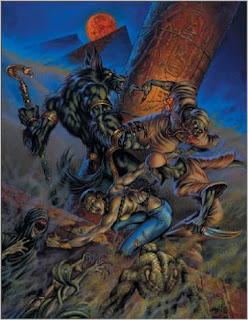
 Onyx Path Publishing has announced their newest Kickstarter, Shattered Dreams the latest book for Werewolf:  The Apocalypse 20th Anniversary Edition.  Shattered Dreams offers storytellers and players a chance to explore the ancient history of the Garou tribes and their degenerating relationship with the other Changing Breeds.  Although Gaia created each of the Fera to fulfill a role in her grand design, the Garou – in their hubris – believed they could usurp the roles of the others.  Shattered Dreams explores the causes of the War of Rage and gives players a chance to affect the outcome of the war.  Culminating in the genocide of the Grondr, the wereboars, and Apis, the wereaurochs, the War of Rage is one of the great tragedies in the prehistory of the Classic World of Darkness. 
            Shattered Dreams also discusses the Second War of Rage, the conflict between the native Mesoamerican Fera and the invading European Garou which occurred simultaneously with the Spanish Conquest of the Aztec, Incan, and Mayan empires.  The Second War of Rage resulted in the complete destruction of another Changing Breed, the Camazotz or werebats. 
            The previous Onyx Path Kickstarters have all been great, but Shattered Dreams is special!  I am one of the authors!  I contributed Chapter Four which details the Second War of Rage and the werewolves’ slaughter of the native Central American shape changers.  Writing for Onyx Path Publishing is a dream come true.  I’ve wanted to be a writer for as long as I can remember.  Not only am I going to be published, but I’ve contributed to one of my favorite games, Werewolf:  The Apocalypse.  I can’t say what it means to me to have had the opportunity to work on this project.  Thank you Stew!  I will never be able to express my gratitude to you for taking a chance on a first time writer!

            I don’t want to go into too much detail about the chapter that I wrote.  However, I was fortunate to write about a topic that I already had a lot of interest in, the Spanish conquest of Mesoamerica.  I’d like to thank Dr. Steven Bunker at the University of Alabama who inspired my interest in Mesoamerica and the Spanish Conquest.  Dr. Bunker introduced me to Eduardo Galeano’s Open Veins of Latin America which was the main source for the tone and mood that I wanted for my chapter in Shattered Dreams.  Thank you Dr. Bunker for being a great teacher and helping a former student remember the name of that book! 
            A lot of people are involved in the creation of an RPG book including development, writing, editing, illustrating, art direction and so many other tasks, big and small.  I want to thank you all!  If I miss someone, please let me know and I will joyfully add you to the list.  First, I want to thank the other writers, Geoff Skellans, Nick May, Leath Sheales, and Nathan Dorey.  They were amazing to work with. 

            A very special thanks to the editor of Shattered Dreams who is currently fixing all of the typos, errors, and issues in my final draft.  Sadly, due to the nature of freelance writing, I don’t know who the editor is.  Nevertheless, thank you!  A big thanks to Mirthful Mike and his crew of artists!  I can’t wait to see the illustrations that you’ve created for Shattered Dreams! 
            I know I’m gushing a bit, but I really want to thank Stew Wilson, the Werewolf:  The Apocalypse developer, for helping me through this project.  I’m sure it wasn’t easy reading over my first draft, but Stew, your redlines were some of the best writing feedback that I’ve ever received!  I learned more about revising and proofreading from Stew’s redlines than I did in my entire college education. 
            Finally, a very big thanks to Rich Thomas and the rest of the crew at Onyx Path Publishing.  Your work has made the return of the Classic World of Darkness possible.   I can’t wait to see what’s around the corner. 
In any book, only so much space is available to acknowledge those who inspired us and motivated us throughout the writing process.  So, I’ll use this space for that.  First, I’d like to thank my wonderful girlfriend, Allisa, who motivated me to send in a writing sample to the Onyx Path.  Without her, I never would have had the courage to send in that writing sample.   I’d like to thank my family, especially my parents who have done so much for me.  I’d like acknowledge my great grandmother who helped raise me.  She instilled so many lessons in me and helped make into the man I am today. 
And of course, I’m saving the most important people for last:  the fans of the Classic World of Darkness, the fans of Werewolf:  The Apocalypse, and the Kickstarter contributors.  Thank you!  This book wouldn’t be possible without you!  Your loyalty and love for the Classic World of Darkness and Werewolf:  The Apocalypse specifically has made this all possible.  I hope that you enjoy reading this book as much as I enjoyed writing it! I can’t wait to hear about the campaigns that you will run based on the settings and information in Shattered Dreams. 

Monday, August 12, 2013

Late Review: Clanbook Gangrel


Clanbook Gangrel
By Brad Freeman
1993, 66 pages

            While other clans, like the Followers of Set or the Assamites, are independent of any one sect but have a defined internal hierarchy, the Gangrel, depending on edition and metaplot, claim membership in the Camarilla; however individual clan members are almost islands onto themselves.  Gangrels travel between cities, explore the wilderness, and rarely stay in any one spot for very long; as such, Clanbook Gangrel is written as if it were an inworld guide for newly embraced Gangrel.  The authors, Dr. Raoul King and his sire Lord Aston, explain the history and culture of the clan and the clan’s relationships with Lupines and Gypsies. 
            The major theme of Clanbook Gangrel is storytelling.  Everything in the book revolves around how Gangrel pass along stories as they meet in their travels.  According to this clanbook, whenever two Gangrels meet, they will sit and share stories of their exploits or stories they’ve head in the past.  These meetings pass along the oral history of the clan, but this book, as an inworld artifact, is essentially the most important of those stories as selected by Lord Ashton and edited by Dr. Raoul King.  Lord Ashton explains Clan Gangrel’s history and Dr. Raoul King discusses the modern relationships of the Gangrels with the other clans. 
If the name Dr. Raoul King sounds somewhat familiar to you, it is because Clanbook Gangrel is dedicated to Hunter S. Thompson who named the protagonist of Fear and Loathing in Las Vegas Raoul Duke.  Having Hunter S. Thompson, as a vampire, writing the Gangrel’s manual is not so much a giant leap in logic.  Thompson could well have been just about anything or anyone to any person.  However, the real author of the book doesn’t attempt to mimic Thompson’s writing style.  If you’re going to have one of the most insane journalists of the 20th century as your author, then go all the way. 
The first chapter of Clanbook Gangrel covers the clan’s history as known by the clan itself.  This history deviates from the known history of the other clans.  Instead of starting with Caine, the history of the Gangrels starts with Lilith.  After being expelled from the Garden of Eden, Lilith wanders the world and eventually gives birth to 4 children who are each raised by a different animal, a wolf, a bear, a tiger and a serpent.  These children eventually became the progenitors of the changing breeds.  Ennoia, the child raised by wolves, became the first werewolf, and she gave birth to more.  Eventually she traveled to Enoch, the first city, where she was famed for her beauty.  She also had children with the citizens of Enoch, and these children became the proto-gypsies.   She left Enoch and was eventually Embraced by one of Caine’s childer, and afterwards, she founded the Gangrel clan as she traveled the world Embracing mortals herself. 
Much like their Antediluvian ancestor, the Gangrel never stop traveling.  Eventually Gangrel spread throughout the world.  Often they acted as the scouts for Kindred looking to expand.  They spread to the New World with Vikings and early European settlers.  They spread to Australia before the first Europeans arrived and Embraced Aborigines.  Gangrel have spread to the far corners of the world, and the only continent where they don’t have a presence is Antarctica.  No one goes to Antarctica.
Chapter Two is devoted to a discussion of Gangrel culture.  Brujah have Rants and Toreador have parties.  Gangrel have Gathers, which are essentially the same as a Brujah Rant. The major difference is that Gangrel Gathers have a storytelling component.   A truly great Gangrel storyteller can keep his audience so enthralled they’ll stay up all day listening to hear the ending.  Because of their love for the wild places, Gangrel encounter Werewolves frequently.  Some Gangrel even develop tenuous friendships with the Lupines, and very lucky few have been rumored to have joined Werewolf packs.   According to a section written by Dr. Raoul King, Gypsies are known to help Gangrels on occasion because of their supposed shared ancestry; however it can be a risky proposition as some Gypsies may not welcome any vampires. 
            Given that the Gangrel are shapeshifters and travelers, I understand why they have connections to werewolves and Gypsies.  Clanbook Gangrel puts this in a favorable light because it’s “authors” are Gangrels, but these allegiances are romanticized.  They don’t have the tinge of danger and potential horror that should accompany interactions between Gangrels and Gypsies.  Seeking an allegiance with a pack of werewolves is outright suicide for most vampires, and only the rarest and luckiest Gangrels are going to succeed.  Clanbook Gangrel is meant to provide the beginnings of the connective tissue that will bring the whole World of Darkness together.  Because it was printed in 1993 originally, just after the publication of Werewolf the Apocalypse in 1992, this section on Gangrel and Werewolf relations bridges the gap and creates a larger world where sometimes a vampire and a werewolf can ally.  World of Darkness:  Gypsies came out in 1994 and because both the Gangrel and Ravnos are associated with Gypsies, Clanbook Gangrel offers a hook into that future book as well. 
            Written by Dr. Rauol King, Chapter Three explores the relationships between Gangrel and other Kindred as well as hunters (of the Hunters Hunted variety) and other supernatural creatures.  Dr. Rauol King’s opinions on the other Camarilla clans are what you’d expect from a typical Gangrel.  The Toreador are “absolutely worthless” and the Tremere are “manipulative, organized, secretive and treacherous.”  Of particular note is the opinion on the Sabbat because it’s not really negative.  Instead they are called honest and don’t wander around in perpetual angst about their existence.  If nothing else, this is a view that was prevalent during First Edition because the primary conflict was between the Elders and the Anarchs.  The Sabbat weren’t as important in the metaplot, yet. 
            Following the section on “Relationships with Other Kindred” the book finally breaks character and discusses a few additional rules for Gangrels.  One additional level of Protean is introduced along with two Merits and one Flaw.  Also included is another section on how Gangrel can intergrate themselves with a Werewolf pack.  These rules cover how a Gangrel can mimic some of the abilities of a Werewolf and what abilities the Gangrel can never learn.  The many forms of a werewolf, Lupine language, etc. are covered here as well.  Of particular not is what a vampire looks like in the Umbra:  Vampires are pale and surrounded by a cloud of spirits that haunt their steps.  What the spirits are is only hinted at. 
            The section on Disciplines should have been larger.  Protean offers so many possibilities for characters that develop it beyond Level Five.  This would’ve been the perfect chance to introduce variants that would let a Gangrel gain more control over what shapes he/she can take.  Also, because of the amount of material on Werewolves in this book, this would have been the opportunity to include a Level 6 Protean ability that allowed a Gangrel to replicate the Werewolf’s Crinos Form. 
This art is so '90s that I think Rob Liefield may have drawn it!
            The final chapter offers ten templates for players and storytellers to use in their games.  None of the templates are really obvious Gangrel stereotypes, and some of them are really creative.  The Archon in Training is a bruiser with plenty of points in combat abilities and is obviously looking to work his way up through the Camarilla’s hierarchy.  The Biologist is looking to make sense of the vampiric condition through science.  The Stuntman is the real standout because it’s such a simple but fun archetype that mixes action with the charisma of someone used to performing in movies.  As a big fan of Quentin Tarantino’s Death Proof, I always picture the Stuntman as Kurt Russell as Stuntman Mike, driving that big black Chevy Nova SS 396.  He’s so smug and winks at the camera just before he murders the first girl. 
If a player ever smiles like this, you KNOW it's about to get awesome!
            On the other hand, three of the templates are of limited use.  The Survivalist Template is better used as an NPC.  He’s too much a loner but could make a great antagonist for wilderness based stories where a group of Vampires are on the run and find a bunker.  The Lupine Impersonator Template could be fun if the Chronicle makes use of a lot of Werewolves or plots involving Werewolves that are not outright antagonistic to the PCs.  Otherwise, this template could be completely useless or just character suicide.  Finally the Babe in the Woods Template is a probably the most difficult to role play template that I’ve seen.  The Babe in the Woods is a character that doesn’t realize that he/she is a vampire.  Integrating that character into a Chronicle would be difficult at best, but for a role player looking for a challenge, this is the character I’d recommend. 
             The Appendix of notable Gangrel is the most disappointing part of the book.  Three NPCs are introduced, Dr. Raoul King, Karen Anotos, and Harbard, and one group the Waelkyrige.  Only Dr. Raoul King is given a decent write up, and we already know who he is because he part of the Clanbook.  Karen Anotos, an actress, like Elvira, who played vampires when she was mortal, is given such a short description that I’ve just said everything important about her.  The Waelkyrige are a group of Valkyrie who have a better explanation in another book, according to Clanbook Gangrel.  The reason that the Appendix is so disappointing is because of the wasted space that could have been used to further flesh out these characters. 
            On the whole, Clanbook Gangrel is one of the better clanbooks.  The fact, that it’s a book about Gangrel, written by Gangrel, and as guide for new Gangrel, means that the information can be as true or false as the Storyteller and players decide.  It does have shortcomings such as the lack of additional variations on high level Protean and the poor descriptions of the Notable Gangrel in the Appendix.  Storytellers looking to include Werewolves or Gypsies into their games will find this book the most useful.  Any Gangrel player should enjoy reading through this book, especially the history of the Gangrel clan. 
            Clanbook Gangrel is available as a PDF at DriveThruRPG.com or you can purchase an original printing at Amazon.com


Friday, May 24, 2013

Late Review: Werewolf the Apocalypse 20th Anniversary Edition


Werewolf the Apocalypse 20th Anniversary Edition
By Bill Bridges, Satyros Phil Brucato, Brian Campbell, Jess Hartley, Matthew McFarland, Holden Shearer, Ethan Skemp, Eddy Webb, and Stewart Wilson
2012, 555 pages


            Werewolf the Apocalypse 20th Anniversary Edition was the third book generated by CCP Games, Onyx Path Publishing, and White Wolf Game Studios as part of the rebirth of the Classic World of Darkness line on Kickstarter.  Along with Vampire the Masquerade’s 20th Anniversary Edition and the continuation of the Mage the Ascension Convention Books (Progenitors and N.W.O.), this volume represents the truth rebirth of the Classic World of Darkness.  While the Convention Books for Mage continue a line that went defunct when the Classic World of Darkness line ended in the early 2000’s and the publication of the Vampire 20th Anniversary book was a celebration of VtM, Werewolf’s 20th Anniversary Edition is a complete role playing book including both the lore and mechanics that old fans loved but also offers the hand holding and exposition needed to bring new fans into the Classic World of Darkness. 
The 5 forms of a werewolf
            Dark and moody settings mixed with contradictory and evocative lore were always the hallmarks of the Classic World of Darkness.  Those elements are front and center from the very first page of the introductory comic which sets the mood for the entire book.  Werewolf the Apocalypse is a game of violence and conflict.  The werewolves, or Garou as they refer to themselves, battle against the Wyrm, a spirit of pollution, violence, and corruption, that infects people and organizations.  The Garou see themselves as warriors that protect the wild places of the world from the further deprivations of greedy corporations and the CEOs possessed by the Wyrm.  With their ability to change between five separate forms, a regular human, a stronger human form, the classic werewolf, a dire wolf form, and a regular wolf, the Garou are built for combat.  However, as powerful as they are in combat, the Garou are fighting a losing battle against the Wyrm, and the final days are coming, perhaps even the end of the world.  The Garou’s battle against the Wyrm is not one that they can win with violence, and that makes them tragic heroes. 
            The legends of the Garou and their place in the World of Darkness are explained in the first chapter. This isn’t a list of the werewolves’ victories but rather a long list of the tragedies that befell them across the centuries.  Tribe fought Tribe.  Hubris led tribes into corruption.  All the while, the Garou lost ground to their real enemies.  In present day, the war continues, and in this time of conflict, the players enter the fray.  The complex nature of Werewolf the Apocalypse offers many different ways to play, whether it’s a fighting over dominance of a pack, politicking between different groups, or taking the fight to the Wyrm. 
            Players start as a member of one of the thirteen tribes.  Each tribe has its own views on the world.  The Red Talons, a tribe comprised wholly of werewolves who were born wolves, hate humans and blame them for the ills of the world.  The Glasswalker Tribe is more focused on technology and cities at the expense of their animal nature.  The Silver Fangs claim rulership over all the werewolf tribes, but their bloodlines have become weak from inbreeding with human royalty.  Furthermore, Garou are categorized by what phase of the moon they were born under, or Auspice, which determines their role in Garou society.  If a Garou was born under the new moon, he is a trickster, but if the Garou was born under the Full Moon, she is a warrior.  Lastly, a werewolf’s breed is determined by its parents.  The union of a human and a werewolf creates a Homid, the union of a wolf and a werewolf creates a Lupine, and the union of two werewolves create a deformed, sterile Metis.
            While all of this sounds complex, Werewolf the Apocalypse’s character creation is simpler than most other RPGs.  Characters can be made quickly and easily.  The hardest part of character creation is deciding on a concept and then choosing between  the large variety of tribes.  The breed, auspice, and tribe determine the character’s starting Gifts, special powers taught by spirits, that offer additional abilities, such a healing, greater damage, and commanding or summoning spirits.  There is a huge variety of Gifts available separated into six levels. 
            The mechanics of Werewolf the Apocalypse will be familiar to anyone who played it before or have experience with other White Wolf games, like Vampire or Changeling.  However, this is a system which focuses more on combat than the other White Wolf games.  A brutal and varied set of special attack maneuvers give players a huge list of options to tear their opponents apart with claws and teeth.  Low Blows, Curbstomping, and Wishboning are just some of the great examples of these ferocious attacks.  If you’re curious, Wishboning is when you grab your enemy by two of its limbs and pull.  (I wished that the Mage Kickstarter will happen soon.)
            While much of the action occurs in the physical world, the Garou also spend time in the spirit world communing with spirits of the wind or their ancestors, for example.  This spirit world, the Umbra, adds another level of depth and complexity.  With many different realms, spirit inhabitants, and rules, this is the one section of Werewolf that is overwhelming.  The spirit world offers a chance to explore all manner of possibilities from idyllic wilderness to polluted wastelands and even realms ruled by faeries.  Each offers a chance to tell a great story but requires a lot of planning on the part of the Storyteller to be used effectively. 
Actual page from the book for the Weresharks
            This book really shines in the chapters describing the allies and enemies of the Garou.  The allies section offers many more options for character creation including other changing breeds, shapeshifters based on animals besides wolves.  Werecats, weresharks, and the like populate this section, but they do not overwhelm the Garou.  Their sections give just enough information for them to be playable, but a future supplement will provide more detail.  Also provided are details on playing the three tribes that have gone extinct:  the Bunyip, Croatan, and White Howlers.  The enemies of the Garou are just as diverse.  Each enemy whether it is a corrupted spirit or a possessed human is given plenty of detail.  However, none of these are given specific stats, but rather suggested ranges and notes on creating creatures.  This allows individual Storytellers to craft appropriate encounters for their groups without being tied down by specific stats.  It also removes the need to have a huge variety of one type of enemy that each need a prewritten block of stats.  Perhaps the best part of this section is that many of these enemies are playable if the group decides they want to be the villains rather than heroes.  A troupe of corrupted werewolves called Black Spiral Dancers ravaging the sacred places of the Garou could make a great campaign. 
            Perhaps my favorite enemy of the Garou is the megacorporation Pentex who have their fingers in every evil, polluting corporation in the world, including Sunburst Computers which manufacturers shoddy mass produced PCs and the anarchist groups, Incognito (think Anonymous) which maliciously attacks and threatens their victims by hacking systems.  The conspiracy theory that an anarchist movement is really just a bigger part of a bigger, evil corporate empire speaks to the paranoia present in the World of Darkness and provides some excellent social commentary.  Also, Black Dog Games, the World of Darkness analogue of White Wolf Games, returns, but they have been bought out by a Scandinavian company and are currently working on an MMORPG that will hopefully dominate its users’ lives.  It’s good to see that the writers have a great sense of humor still.
            As good as this book is, it’s not perfect.  Perhaps the most annoying problem is a pair of typos in the Example of Play section.  Apparently, this was brought over from an earlier edition without being proofread.  In the 20th Anniversary Editions, when a player rolls a ten, it is counted as two successes, but in previous editions, that ten was rolled again for a chance at an additional success.  The Example of Play uses the older rule.  This error should have been caught and corrected before the PDFs were made available, especially because this is supposed to be an example of how to run the game. 
            A more general issue with the game is the lack of Level 6 Gifts for every Tribe.  While it’s rare that characters will reach that level of play, the clans that do have access to Level 6 Gifts are potentially much better.  Every clan should have been given at least one Gift at this level as it would improve game balance at high level play. 

Werewolf the Apocalypse’s 20th Anniversary Edition is nearly overwhelming in its thorough and loving resurrection of Werewolf the Apocalypse.  Every aspect of Werewolf is brought into this massive book including all the major tribes, the extinct tribes such as the Croatan, all the changing breeds, their Wyrm tainted enemies the Formori and Black Spiral Dancers, and even the Skin Dancers who murder and skin werewolves to become werewolves themselves.  While maintaining the broad scope of the 20th Anniversary Edition line (with Mage 20th coming soon), Werewolf’s 20th Anniversary Edition is more than a love letter to fans, it’s an encyclopedic volume that gathers much of 2nd Edition and Revised Edition into one book.  Not every Gift is present and not every detail is included, but the developers and writers have chosen from the multitude of previously published White Wolf products and included the best and more important aspects of the Werewolf canon.   
Whether you are new to Werewolf the Apocalypse or an old fan, you will find this book a great, if dense read.  While a physical copy of the book is expensive, starting at $49.99 (US Dollars), gamers won’t need to purchase any other books.  The PDF is only 29.99 and discounts are available if you purchase both a PDF and physical book.  Everything is included within this expansive tome including tons of potential enemies, a great section on running a chronicle, lots of options for characters, and a gloriously brutal combat section.  If you are looking for a new RPG to play, I highly recommend this system.  And personally, I cannot wait to run my first Werewolf the Apocalypse game. 
Werewolf the Apocalypse 20th Anniversary Edition is available for purchase at DrivethruRPG as either a PDF or physical book.  The physical book is offered in three versions: a black & white version, a standard color version, or a deluxe color version.